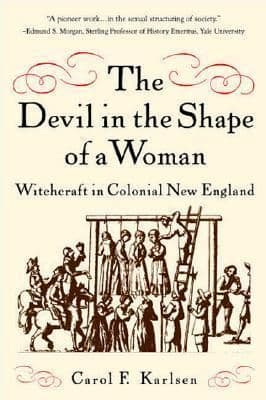
The Devil in the Shape of a Woman
by Carol F. Karlsen
"A pioneer work in the sexual structuring of society. This is not just another book about witchcraft."
Synopsis
Mary Johnson, a servant, was executed for witchcraft in Connecticut in 1648. Ann Hibbens, a wealthy Boston widow, was hanged in 1656. Ann Cole's mysterious fits triggered a wave of witchcraft accusations in Hartford a generation before Salem. These women were not outliers — they were part of a pattern. In The Devil in the Shape of a Woman, historian Carol F. Karlsen asks the question that haunted seventeenth-century New England: why were women the ones accused? Drawing on court records, probate documents, demographic data, and Puritan writings, Karlsen constructs a meticulous and revelatory portrait of the accused. Her answer is as unsettling as it is illuminating: witchcraft accusations were not random. They fell overwhelmingly on women who stood to inherit property, who challenged social expectations, or who occupied positions of uncomfortable independence in a rigidly patriarchal society. This is not just a history of witch trials — it is a history of how power works.
Our Take
First published in 1987, The Devil in the Shape of a Woman remains one of the most important works of feminist history ever written about colonial America — and it has