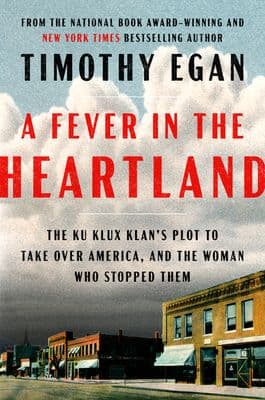
A Fever in the Heartland
by Timothy Egan
True Crime
History
Politics
404 Pages
"A master class in the tools of narrative nonfiction: high stakes, ample suspense, and sweeping historical phenomena made vivid through the dramatic actions of individual villains and heroes."
Synopsis
The Roaring Twenties were not just an era of jazz and Gatsby glamour — they were also the height of the Ku Klux Klan, whose reach extended far beyond the old Confederacy into the American heartland and West. At its peak the organization claimed six million members, including judges, senators, governors, and ministers who openly proclaimed their affiliation. The architect of this terrifying expansion was D.C. Stephenson, a charismatic con man and sexual predator who rose to become Grand Dragon of Indiana within two years of arriving in the state. His strategy was audacious: bring the Klan out of the shadows and into the mainstream, endorsed from church pulpits and celebrated at family picnics. But at the height of his power, it was Madge Oberholtzer — a seemingly powerless woman — who would expose his secret cruelties. Her deathbed testimony set in motion the events that finally brought Stephenson and the Klan to their knees. A Fever in the Heartland is narrative history at its most urgent and propulsive.
Our Take
Timothy Egan is one of the finest practitioners of narrative nonfiction working today, and A Fever in the Heartland may be his most essential book yet. He has the rare ability to make history feel like a thriller — the pacing is relentless, the characters are fully drawn, and the story builds to a courtroom reckoning that is genuinely suspenseful even a century after the fact. What makes it especially powerful is how little distance exists between the 1920s Egan describes and the present: a hate movement mainstreamed through respectability, politicians laundering extremism through civic language, a woman's testimony dismissed and then weaponized. David Grann called it "compelling, powerful, and profoundly resonant today." Ken Burns said it should "put a chill in every American." Both are right. The Washington Post called it "a master class in narrative nonfiction," and it earned starred reviews from Kirkus, Publishers Weekly, Booklist, and Shelf Awareness. Readers who loved Grann's Killers of the Flower Moon, Erik Larson's The Devil in the White City, or Egan's own The Worst Hard Time will find this essential.