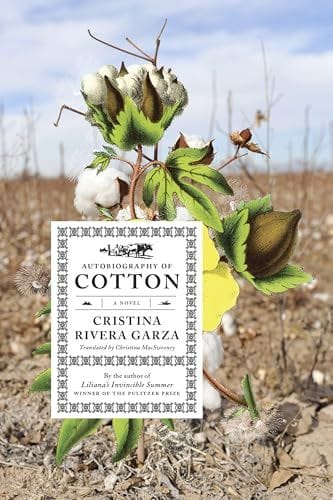
Autobiography of Cotton
by Cristina Rivera Garza
Literary Fiction
Historical
Satire
288 Pages
"Autobiography of Cotton is unlike anything I've read about the border — Rivera Garza makes the land itself feel like a character, and the history she uncovers is both devastating and necessary."
Synopsis
In 1934, a young José Revueltas traveled to Tamaulipas to witness the cotton workers' strike at Estación Camarón — an experience that became the foundation for his landmark novel Human Mourning. In Autobiography of Cotton, Pulitzer Prize–winning author Cristina Rivera Garza recounts her own grandparents' journey from Mexico's mining towns to those same cotton fields, reconstructing the moment their story intersects with Revueltas's in the borderlands between Mexico and the United States. Drawing on archival research and personal narrative, Rivera Garza chronicles how cotton cultivation transformed the landscape and the people who worked it — and how cycles of deprivation, labor exploitation, and environmental devastation persist across generations. Part intimate family history, part political excavation, the novel reconstructs the 1934 strike and the social world surrounding it: agricultural colonization, cross-border migration, labor activism, and the ecocide quietly unfolding across brittle, overworked land. Deeply personal and politically acute, it is a new kind of border novel — one that insists the land itself is a record, and that the lives of ordinary workers deserve the same attention as the revolutionary writers who passed through.
Our Take
Cristina Rivera Garza won the Pulitzer Prize for Liliana's Invincible Summer, her forensic, grief-driven reckoning with her sister's murder, and Autobiography of Cotton confirms that her range is as remarkable as her precision. Where Liliana's Invincible Summer worked as personal excavation, this novel expands outward — into landscape, labor history, and the literary archive — without losing the intimate thread of family at its center. Rivera Garza's method here is genuinely hybrid: archival research folded into fictionalization, personal narrative braided with political history, the individual life set against the slow violence of agricultural colonization. It's a demanding but deeply rewarding approach, one that asks readers to hold multiple registers simultaneously. The decision to structure the novel around cotton itself — a crop whose history is inseparable from exploitation, migration, and environmental ruin — gives the book an ecological dimension that feels urgently contemporary. Readers who admired Ana Castillo's So Far from God or Valeria Luiselli's Tell Me How It Ends will recognize the same commitment to the borderlands as a site of layered, unresolved history. And for readers drawn to the documentary novel tradition — W.G. Sebald, say, or Jenny Erpenbeck's Go, Went, Gone — this is essential, formally ambitious work.